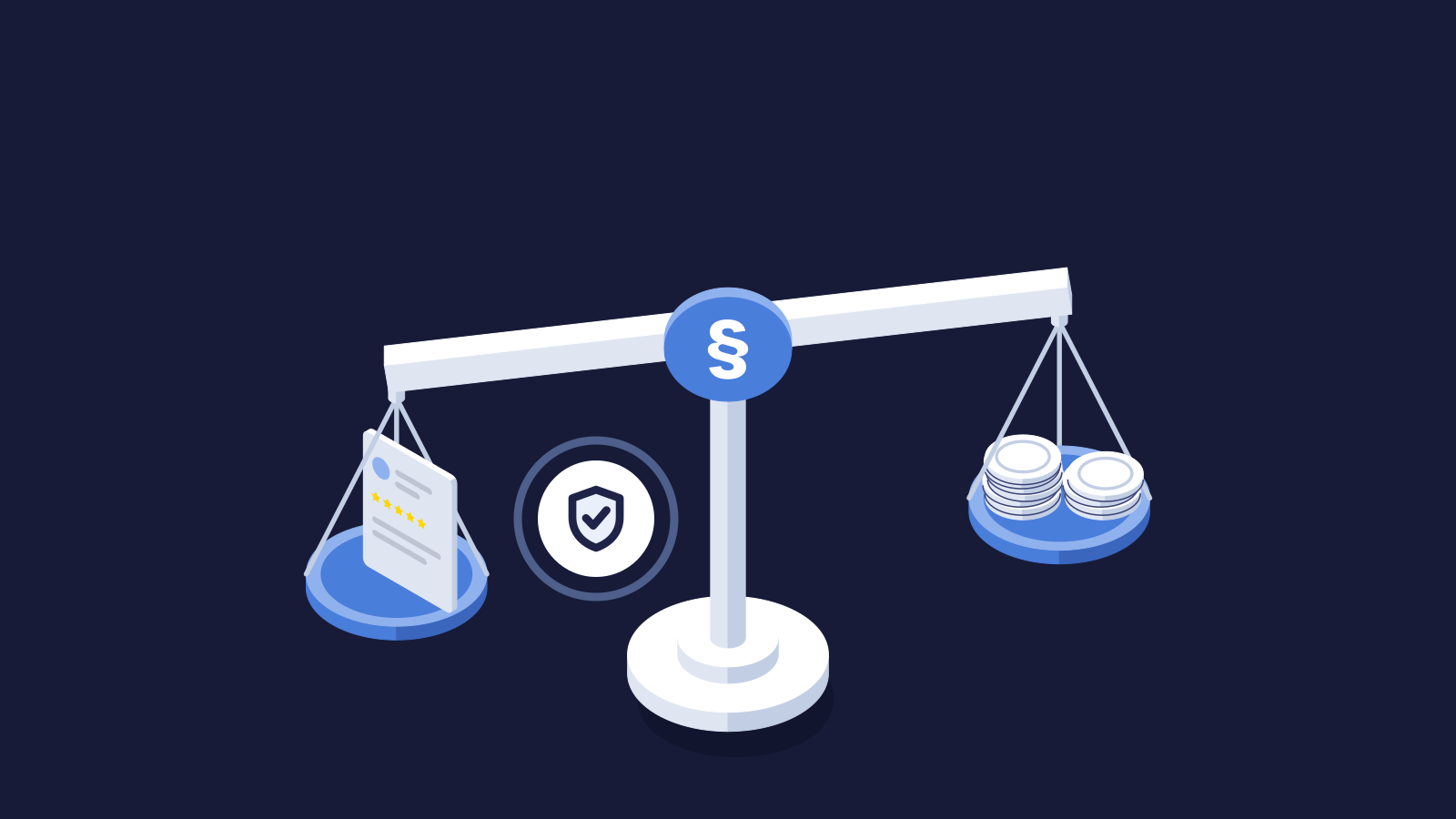
Searching for "buy Google reviews" usually means a real problem: too few stars, too few voices, a competitor with a three-digit review count. Before booking an offer from the gray zone, it pays to look at the legal situation clearly: since the 2022 amendment of the German Unfair Competition Act (UWG), fake reviews are no longer merely "frowned upon" but explicitly prohibited and backed by substantial fines. This guide explains exactly what is banned, what remains legal, how Google detects fake reviews, and how to build a strong review profile the legitimate way.
Quick answer: what is allowed and what is not
| Practice | Legal status | Risk |
|---|---|---|
| Buying fake reviews from agencies or marketplaces | Prohibited (Annex to Sec. 3(3) UWG, items 23b and 23c) | Fines, cease-and-desist letters from competitors, removal by Google, profile penalties |
| "Real" reviews from paid accounts with no genuine contact with the business | Equally prohibited: what matters is the content, not the account | Same risks |
| Actively and neutrally asking your own customers for an honest review | Allowed and recommended | No legal risk |
| Incentives for a review | Only permissible if the incentive is disclosed and the review reflects a genuine experience; Google restricts incentives further | Without disclosure: cease-and-desist; violating platform rules: removal |
| Only asking satisfied customers and filtering out unhappy ones ("review gating") | Misleading and against platform policies | Cease-and-desist, removal, profile measures |
The core in one sentence: nothing may be bought, but a great deal may be collected, under fair conditions.
What "buying reviews" actually means on the market
Three completely different business models hide behind the same search term. Telling them apart is the most important step before any decision.
1. Fake review agencies
They deliver reviews from accounts that have never been your customer. The texts are produced by writers, AI systems or click farms, and the accounts look real at first glance: with history, profile photos and reviews for other companies. Exactly this kind of offer has been legally prohibited in the EU since May 28, 2022, regardless of how "genuine" the account looks.
2. Review platforms with incentive models
Here, real people review in exchange for vouchers, discounts or small payments. This is legally permissible only under strict conditions: the reviewer must have genuinely experienced the product or service, the review must reflect their honest opinion, and the incentive must be disclosed. If an offer fails any of these conditions, it constitutes a prohibited fake review.
3. Systematic review management
Not buying individual reviews but running a process: customers are consistently asked for an honest opinion at the right moment, incoming reviews are consolidated and answered, and the company learns from the feedback. This is legal, scalable, and exactly the model that gets businesses to three-digit review counts, without a single purchased voice.
The legal situation: why bought reviews are expensive in 2026
The ban has been written into law since 2022
With the implementation of the EU Omnibus Directive, two items were added to the annex of the UWG. That is the list of practices that are inadmissible in every case, without a court having to examine deception in the individual case:
- Item 23b: It is prohibited to claim that reviews come from consumers who actually purchased or used the product, without taking reasonable and proportionate verification measures.
- Item 23c: It is prohibited to submit or commission fake consumer reviews or to falsify endorsements in order to promote products.
"Commissioning" applies not only to the agency but expressly to the advertised business. Whoever buys is acting themselves.
The possible consequences
- Fines: Violations of the prohibition list can be sanctioned with fines; for widespread infringements prosecuted in coordination across member states, Sec. 19 UWG provides for fines of up to four percent of annual turnover.
- Cease-and-desist letters: Competitors and consumer protection associations can send costly cease-and-desist letters over the prohibited practice. Anyone who signs a declaration to cease and desist and continues to buy risks contractual penalties in the five-figure range, per case.
- Platform measures: Google removes detected fake reviews, can restrict the profile, temporarily block new reviews, and display a warning notice on the profile in conspicuous cases. The purchased stock is then not only gone; the profile is damaged for months as well.
- Lost investment: The agency will not pay after deletion. A "bought reputation" is a good with no durability and no warranty.
How Google detects fake reviews
Google does not publish the details of its detection, but its policies and moderator statements reveal which patterns count as "fake engagement." In practice, purchased reviews are caught by the same signals that cease-and-desist lawyers and competitors use to inspect profiles:
- Temporal clusters: Ten five-star reviews in 48 hours for a business that normally receives two reviews a month.
- Account patterns: Accounts with no local history that review a service provider in Hamburg, a dental practice in Munich, and an online shop in Spain in the same week.
- Text similarities: Recurring phrases, unusually generic praise without a concrete experience, identical sentence structures across different accounts.
- Location and device data: Reviews from regions where the business has no customers, or from identical networks.
- One-off activity: Accounts that post exactly one review (the purchased one) and never become active again.
The decisive factor is the sequence: Google often does not delete immediately but collects evidence. Delayed removal is actually the more unpleasant case, because businesses treat the purchased profile as real for months, until it reverts to the old state overnight.
The legitimate alternative: systematically collecting real reviews
The result buyers are actually looking for (many recent, credible reviews) is achievable by legal means. It does not require an agency contract but a repeatable process.
1. Ask every customer, not just the satisfied ones
Preselecting only presumably satisfied customers ("review gating") is itself a violation of platform rules and legally contestable because it creates a distorted overall picture. What is permitted and effective is asking every customer equally for an honest review. Anyone who knows their product knows the distribution will be predominantly positive anyway.
2. Hit the right moment
The best response rate comes immediately after the success moment: after the delivered order, the completed appointment, the resolved complaint. A request three days later already loses most of its impact.
3. Reduce friction to zero
Every intermediate step costs reviews. A direct link to the review form (as a QR code on the invoice, in the shipping email, or at the end of a consultation) converts intention into actual reviews.
4. Respond to incoming reviews
Replies are a visible signal for future reviewers: people who see that the business reads and responds are more likely to review themselves. Google expressly recommends responding. Details are in the post AI replies to reviews.
5. Run it as a routine, not a campaign
A stream of five to ten genuine reviews per month beats any one-off campaign: the profile grows naturally, stays current, and looks credible even under scrutiny. How reviews concretely affect local ranking is shown in the Local SEO guide.
What is allowed with incentives
Incentives are the borderline area where legitimate review marketing is possible, under three conditions. First, the reviewer must have genuinely experienced the product. Second, the incentive must not be tied to a positive review; compensation "for five stars" is a purchased opinion and therefore prohibited. Third, the incentive must be recognizable to other consumers: missing disclosure turns an honest review into deception.
In addition come the rules of the platforms: Google prohibits content based on incentives or that distorts review results, and removes such reviews even where they might be marginally permissible under the law. Anyone using incentives should therefore align them with their own channels and disclosure duties, or simply take the permanently safe route and generate motivation through quality and good timing.
Frequently asked questions
Is it illegal to buy Google reviews?
Yes, if the reviews are fake, meaning they are not based on real customer experiences. Submitting or commissioning fake reviews has been literally on the statutory prohibition list since the UWG amendment of May 2022. Asking real customers for honest reviews remains legal.
May I reward customers for a review?
Only under strict conditions: the person must have actually used the product, the review must be honest, and the incentive must be disclosed. A reward only for positive reviews is inadmissible. In addition, platforms like Google remove incentive-based reviews under their own policies.
What happens if Google detects purchased reviews?
Google removes the detected reviews and can restrict the business profile, for example by temporarily blocking new reviews or displaying a warning notice. The consequences therefore affect not only the purchased voices but the visibility of the entire profile.
Can a competitor send me a cease-and-desist for bought reviews?
Yes. Fake reviews violate competition law, and competitors can issue costly cease-and-desist letters. The declaration typically includes a contractual penalty that becomes due with every further violation.
Are reviews from "real accounts" safer?
No. The law ties to the content, not the account: a review without a genuine customer experience is fake, even if the account has existed for years and has a profile photo.
How quickly can I legally get more reviews?
With a repeatable request process, five to ten new reviews per month are realistic, and significantly more depending on customer volume. What matters is timing directly after the success moment and a direct link to the form. After three to six months you have a stock no agency can deliver, and one that cannot fall victim to a deletion wave.
Conclusion
"Buying Google reviews" leads to a crossroads with clear signs in 2026: the fast lane via agencies has been explicitly prohibited since 2022 and, in the worst case, costs fines, cease-and-desist letters, and the entire purchased stock. The legal route (asking every customer for an honest opinion at the right moment with minimal effort) delivers the same target picture, only durably.
The bottleneck is rarely the customers' willingness but the routine behind it: requests must go out, incoming reviews must be answered, ideally across all platforms. RateGate helps with the replies: it consolidates reviews from Google, Trusted Shops, and ProvenExpert into one inbox and, from the Silver plan, can answer new reviews automatically with AI. An overview is on the features page.